
Fantasy Football Playoff Odds: How to Understand Your Team's Chances
Fantasy football playoff odds are for the part of the season where everyone starts doing suspicious math.
You are 6-5, but your points scored are strong. Your friend is 7-4, but they have been winning with 91 points and positive vibes. Three teams are tied for the last playoff spot. Someone says they control their own destiny, which usually means they are one loss away from sending 14 screenshots to the group chat.
The standings matter, obviously. But they do not always tell you who is safe, who is in trouble, and who still has a real path to the playoffs. That gap is why I built playoff forecasts into ffwrapped.
A team's playoff chance is not just its current place in the standings. A 6-5 team with strong scoring and an easy remaining schedule can be in a much better spot than a 7-4 team with low scoring and a tough finish.
Why Standings Can Be Misleading
Head-to-head fantasy football is messy.
Some teams get lucky with opponents. Some teams score well and lose anyway. Some teams have already played the hardest part of their schedule, while others are about to run into every contender in the league.
That is why playoff odds are more useful than just staring at wins and losses. They can help separate:
- Good teams with bad records
- Shaky teams with good records
- Bubble teams with real upside
- Teams that need help from the rest of the league
This matters most near the trade deadline and playoff push. A team with a 75% playoff chance should think differently than a team with a 12% chance, even if their records are only one game apart. One team can afford to think about playoff matchups. The other probably needs to chase upside and hope the league gets weird.
How Playoff Odds Are Calculated
A playoff odds calculator usually works by simulating the rest of the season.
It can play out the remaining matchups many times using each team's record, scoring strength, schedule, and league rules. After enough simulated seasons, it can estimate how often each team makes the playoffs. If a team gets in during 720 out of 1,000 simulations, its playoff odds would be about 72%.
The exact method can vary, but the idea is pretty simple: use the information available now to estimate the most likely playoff outcomes. The best versions also account for league-specific details like playoff spots, tiebreakers, matchup schedule, and whether points scored matters for seeding.
ffwrapped's fantasy football playoff odds calculator starts with the imported league state, completed scoring, playoff cutoff, remaining schedule, roster projections, starting-lineup requirements, and scoring format. It then simulates the remaining season 5,000 times with weekly scoring variation. Median-scoring results are included alongside head-to-head matchups when that league setting is enabled.
The result is more than one playoff percentage. The forecast includes top-seed odds, average seed, expected wins, a likely win range, and schedule scenarios that show how opponent timing can change a team's record or seed.
From Playoff Odds to Championship Odds
Making the playoffs and winning the championship are different questions. Playoff odds estimate how often a team qualifies. Championship odds continue each simulated season through the bracket and measure how often that team finishes as champion.
For conventional fixed 4-, 6-, and 8-team playoff formats, ffwrapped plays out the fantasy playoffs after each simulated regular-season finish. Teams receive a new projected score in every round using the same scoring profile behind the season forecast. A team that wins 600 of all 5,000 simulations would have a 12% championship chance.
Premium's Playoff Path also shows the most common bracket route in simulations where a team wins the title, the opponents it is most likely to face by round, and its projected one-game win probability against every potential opponent. These are estimates rather than promises: injuries, lineup changes, trades, and weekly variance can reshape the path quickly.
Leagues with custom playoff formats still receive the regular-season qualification and seed forecast, but championship paths and projected playoff matchups are only available for supported conventional brackets.
What Happens If I Win or Lose?
Your current playoff percentage answers one question: how often does your team qualify in the forecast? The next question is usually more urgent: how much does this week's matchup matter?
Premium's Playoff Path lets you compare Current, Win, and Lose under Next Week Impact. Win gives your selected team the next head-to-head victory; Lose gives that victory to its opponent. The calculator then simulates the rest of the season to show the effect on playoff odds, average seed, and championship chances. Current returns to the forecast without a forced result.
Here is an example from ffwrapped's sample midseason league. Just the Tua Us faces The Princess McBride next:
| Next matchup scenario | Playoff odds | Average seed | Championship odds |
|---|---|---|---|
| Current forecast | 33.6% | 7.2 | 1.2% |
| Win | 48.4% | 6.5 | 1.7% |
| Lose | 24.1% | 7.7 | 0.9% |
A win adds 14.8 percentage points to the team's playoff chance compared with Current. A loss takes away 9.5 points. The gap between winning and losing is 24.3 points. That gives the matchup some stakes without calling it a must-win: even after a loss, this team still qualifies in about a quarter of the simulations.
A lower average seed is better. Moving from 7.2 to 6.5 means a better average finish across the simulations; it does not mean the team is guaranteed the sixth seed.
How to Check Your Next Matchup
- Open ffwrapped's playoff forecast and load your supported Sleeper, ESPN, or Yahoo league.
- In Playoffs, expand Playoff Path and select your team. The detailed comparison requires Premium.
- Under Next Week Impact, check the opponent shown and choose Win. Read each before-and-after value against the current forecast.
- Choose Lose to compare the downside, then Current to return to your baseline forecast.
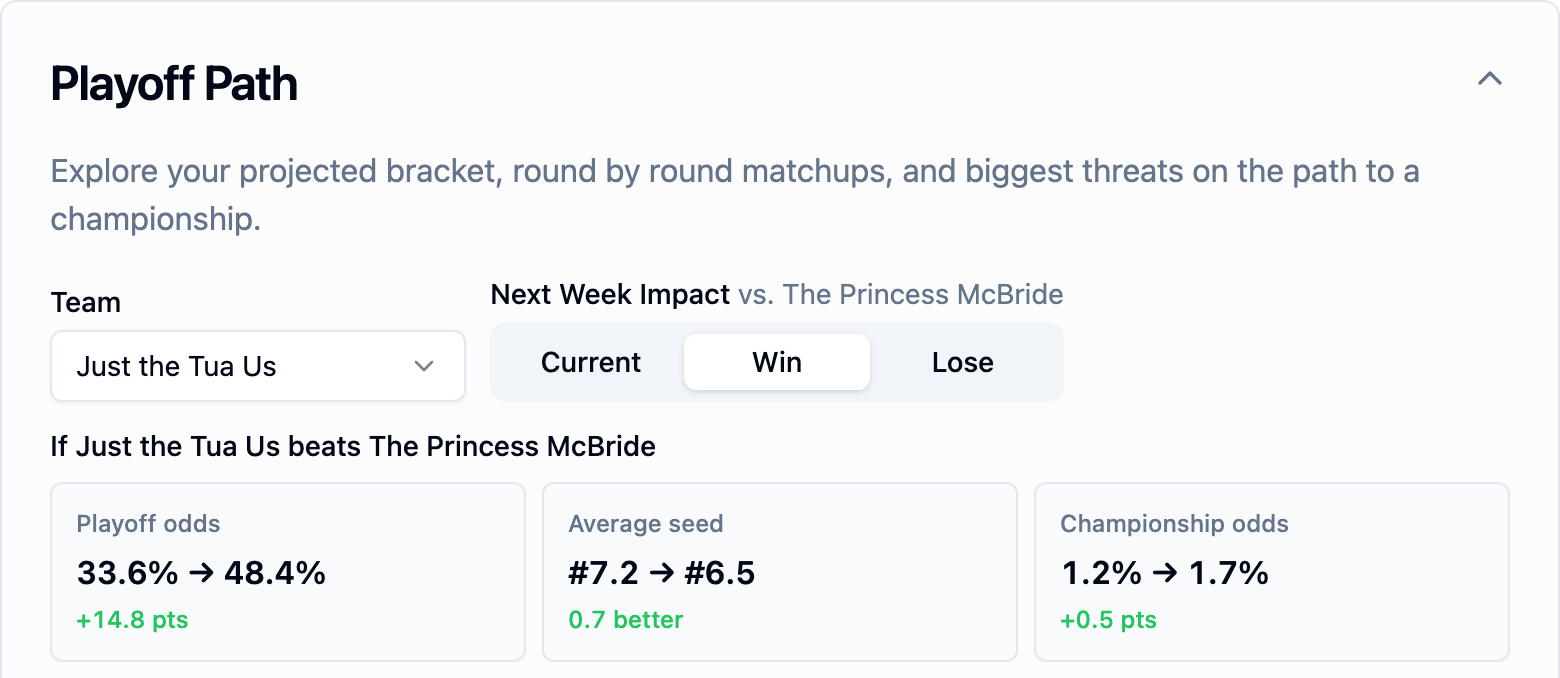
Actual ffwrapped controls using sample midseason data. Your league's numbers will differ.
The comparison is available when a next regular-season opponent is known and the league has a supported conventional 4-, 6-, or 8-team playoff bracket. It changes that head-to-head result, not an exact score or every remaining matchup. In median-scoring leagues, the separate median result still comes from simulated scores.
Use it to understand the size of a swing, not to certify a clinch or elimination. Even a displayed 0% or 100% is a simulation estimate, and updated projections or league results can change it.
When Playoff Odds Matter Most
Playoff odds are useful all season, but they matter most once managers have to make decisions.
If your odds are high, maybe you can trade depth for a better playoff lineup. If your odds are shaky, maybe you need to chase upside on waivers. If your odds are nearly gone, maybe the goal becomes spoiling someone else's season, which is a proud fantasy football tradition.
They also make the league more fun. Instead of saying "I think I still have a chance," you can say "I have a 19% chance and I am choosing to be unbearable about it."
That is the kind of context standings alone cannot give you.
Checking Your League
You can estimate playoff chances by hand, but it gets annoying fast. You have to account for remaining matchups, scoring strength, tiebreakers, playoff spots, and every other team fighting for the same place.
ffwrapped can calculate league-specific playoff odds for supported Sleeper, ESPN, and Yahoo leagues, including projected wins, seed ranges, schedule scenarios, and median scoring when enabled. Premium continues supported brackets into championship odds, likely opponents, matchup probabilities, and simulated title paths.
If a team with a worse record has better odds than the manager ahead of it, that is not necessarily a mistake. Stronger scoring, an easier remaining schedule, or a better tiebreaker position can outweigh the one-game gap.
If you want to understand your team's path, try the ffwrapped fantasy football playoff odds calculator. For related league analysis, read Fantasy Football Power Rankings: A Formula You Can Explain or The Unluckiest Team in Your Fantasy Football League.